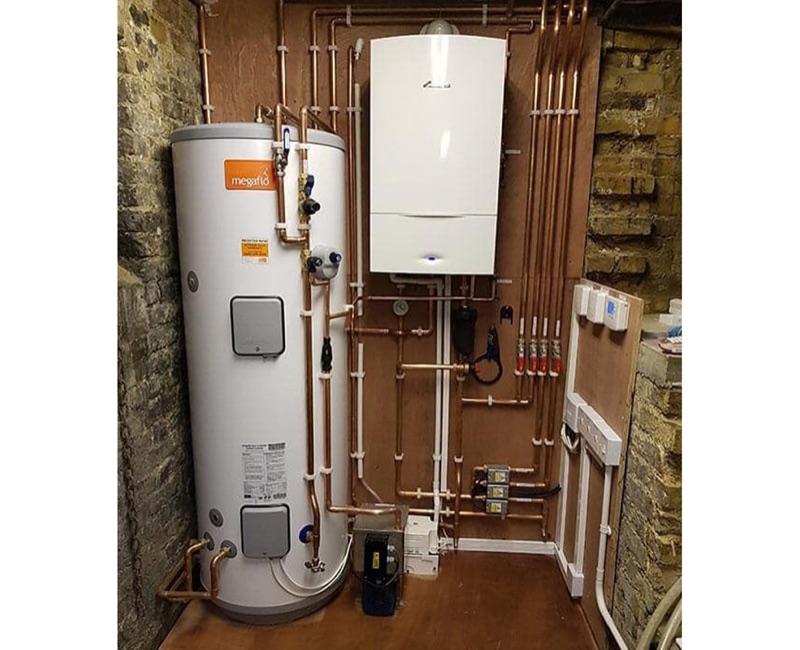
Worcester boiler working but no hot water: start with these distinctions
If your Worcester boiler gives no hot water, first establish whether it heats taps directly as a combi or heats a separate cylinder. Then establish whether every hot outlet is affected or only one. Working radiators narrow the problem, but do not prove that the hot-water controls, heat transfer and delivery to taps are working. A shower-only problem needs a different investigation from cold water throughout the house.
Describe what actually happens before changing anything. Water may flow normally but remain cold, start warm then turn cold, alternate between hot and cold, or barely flow at all. Those are different symptoms even though people understandably search for the same phrase. Include whether the problem began suddenly, after work, after a power interruption or gradually over several weeks.
This guide is for observation and choosing the right help, not opening a boiler or replacing parts. Worcester supplies different appliance families and fuels: the specific control examples below concern the cited Greenstar 4000 gas models. Find your full model in paperwork or on a safely accessible external label. Do not remove a casing to identify it.
If you smell gas or suspect carbon monoxide, leave the building, avoid electrical switches and flames, and call the National Gas Emergency Service on 0800 111 999 from outside, well away from the building. A hot-water inconvenience becomes a different priority when there is a safety warning. Do not continue troubleshooting to obtain a better description before leaving.
| Observation | Useful next distinction | Avoid assuming |
|---|---|---|
| One outlet cold; others reliably hot | Identify the fitting and its actual hot-water source | Whole-boiler failure |
| Combi: all hot taps cold, radiators work | Report external response during normal tap use | A definite diverter-valve fault |
| Cylinder: all taps cold, radiators work | Check the documented hot-water schedule and identify controls | Radiator heat proves cylinder heating |
| Little flow from hot and cold taps | Check supply incidents and building works | Increasing boiler temperature restores flow |
| Very hot then cold water | Stop unsafe use and report the pattern | No code means safe operation |
Sources: HSE gas safety for homeowners
Is your Worcester a combi, system or regular boiler?
A combi normally produces domestic hot water when a tap requests it. A system or regular boiler typically works with a separate hot-water cylinder: the boiler heats the stored supply through the installation's heating arrangement, and taps draw from that store. Worcester's system and regular boiler explanations support this basic distinction. The badge on the boiler alone does not tell you which controls serve every outlet in a modified house.
Look at the installation information you already have. A cylinder in an airing cupboard, a separate hot-water channel on a programmer and cylinder service paperwork help establish the arrangement. There may also be an immersion heater or another heat source. You do not need to enter a loft, trace hot pipes by touch or open equipment to answer the first booking questions. If unsure, send photographs taken safely from the room.
This distinction changes the meaning of opening a tap. With a combi, that action is relevant to the boiler's immediate hot-water demand. With stored water, opening a tap draws available water; it does not necessarily make the boiler fire immediately. Expecting every cylinder installation to respond like a combi creates misleading tests and can lead to a perfectly normal control delay being described as a boiler failure.
It also changes responsibility for diagnosis. A boiler-only inspection may not settle a problem in cylinder controls or downstream plumbing. Tell the person arranging the visit about the cylinder, its manufacturer and any independent electric heating. An engineer needs to understand the complete route supplying the affected taps, not simply the most recognisable brand in the cupboard.
Sources: Worcester system boilers and stored hot water · Worcester regular boiler arrangements
One shower or tap is cold while other outlets are hot
If another outlet supplied by the same hot-water system delivers stable hot water, the evidence points towards investigating the affected outlet and its supply path before assuming the boiler has stopped producing hot water everywhere. That is a useful narrowing observation, not proof that one particular cartridge or valve needs replacement. Establish whether the working outlet really uses the same source; a kitchen point-of-use heater can otherwise confuse the comparison.
A mixer shower uses hot and cold supplies together. An electric shower heats its own incoming water and is a different diagnostic branch. A thermostatic shower also regulates the mixture, so a cold shower does not automatically tell you the boiler outlet temperature. Identify the shower from its model or documentation rather than assuming that every wall-mounted shower takes hot water from the boiler.
Report whether the affected fitting has changed recently and whether the problem is temperature, flow or both. For example, a newly installed bathroom mixer with cold output while the original kitchen hot tap remains normal gives more useful direction than saying the boiler has failed. Do not dismantle the fitting, adjust hidden anti-scald limits or remove an electric shower cover to collect further evidence.
Use the separate no-hot-water-in-shower guide for that narrower problem. If the water becomes unexpectedly very hot, stop using the affected outlet, particularly for bathing children or anyone unable to move away quickly. Avoid repeatedly stepping into the shower to test whether it has recovered. A stable supply at another tap does not make an unpredictable shower safe.
Sources: One shower has no hot water
Cold water flowing is different from no water flowing
When a hot tap has a reasonable flow but the water stays cold, the immediate question is why the supplied water is not being heated or reaching the outlet at the expected temperature. When little or nothing comes out, the investigation also needs to address the water supply and distribution path. Turning up a temperature setting cannot restore a missing water supply.
Compare what you already observe at hot and cold outlets, without leaving taps running indefinitely. If cold taps are also affected, check your water supplier's incident information and whether the building has a known supply interruption. In a flat, ask the building contact whether work or a shared-system problem has been reported. If cold water is normal but all hot outlets have lost flow, tell the attending person exactly that distinction.
Do not confuse the boiler's heating pressure gauge with a measurement of tap flow. A reassuring-looking number does not answer whether water reaches a particular fitting, whether a hot-water request is recognised or whether delivery temperature is stable. Equally, an unfamiliar gauge reading needs the matching manual, not a target copied from another owner's forum post.
After recent plumbing work, describe which outlets stopped working and when the supply returned. Do not turn unidentified valves underneath the boiler or in a communal cupboard to experiment. Labelling and arrangements vary; a photograph and the work history are more useful than adding a second uncertainty. The aim is to separate a supply problem from a heating problem before someone starts quoting boiler components.
Combi heating works but hot taps stay cold
On a combi, successful radiator heating demonstrates one operating condition. It does not establish that the appliance recognises a hot tap opening or delivers heat correctly for domestic water. If it is safe to observe during ordinary use, note whether the external display changes when a hot tap is opened, whether a fault appears and whether the water remains cold or briefly warms. Leave internal checks to the appropriate engineer.
An owner on the UK DIY subreddit described a Worcester that supplied hot water only while central heating was operating. A reply suggested a valve, but the visible discussion did not establish a tested diagnosis or completed repair. The useful question from that account is whether hot-water performance depends on another demand, not which part a reader should order.
Do not run heating unnecessarily as a permanent workaround or assume that a temporary improvement has cured the fault. Tell the engineer whether you noticed the dependency during normal use. If you have already changed a room thermostat, boiler setting or programmer mode, explain that too. Several simultaneous changes make it harder to know which operating condition produced the result.
A good assessment separates the demand, appliance response and delivery outcome. Ask what was tested and why a proposed component explains your symptoms. The same broad complaint can arise with different equipment and circumstances; an internet symptom match cannot replace examination. If the boiler has a recurring fault or abnormal operation, follow its user instructions and arrange help rather than repeatedly resetting it to obtain another short period of hot water.
Sources: Public owner account: hot water dependent on heating; outcome unverified
System or regular boiler: radiators hot but cylinder water cold
With a separate cylinder, the relevant question is whether the stored water has received its expected heating period. Check the visible hot-water programme and whether it matches the household's usual schedule, using the controller's own instructions. A room thermostat calling for radiator heat is not the same observation as the hot-water channel requesting cylinder heating. Do not assume the boiler is being asked to do both jobs simply because it is running.
A DIYnot owner, Shadoman, described intermittent lukewarm water with a Worcester and unvented cylinder in September 2021. Heating worked, and temporary recovery made the fault difficult to pin down. The owner later suspected a valve but remained uncertain about the assembly; the thread did not document a completed repair. This is an individual, unverified account, not evidence that your cylinder needs the same part.
Stored water also introduces timing. A brief check immediately after changing a normal programme does not establish the final result of a heating cycle. Conversely, repeatedly finding cold water after the usual completed cycle deserves investigation. Record the schedule and actual availability rather than raising stored-water settings, bypassing controls or opening electrical covers. If an immersion heater already provides water independently, report that existing observation; do not energise unfamiliar equipment as a test.
Use the dedicated unvented-cylinder no-hot-water guide for detailed cylinder distinctions. Hot discharge, steam or unusual overheating requires prompt appropriate help, not routine programme experimentation. Keep clear, leave discharge routes unobstructed and turn off heat sources only at normal controls if safe. Cylinder safety components and wiring are professional work.
Sources: Public owner account: intermittent cylinder heating, September 2021 · No hot water from an unvented cylinder
Eco, preheat and hot-water settings are not interchangeable
The Greenstar 4000 GR4700iW C user instructions, edition 2020/09, distinguish hot-water operation from preheat. Preheat keeps the heat exchanger ready to shorten the wait; Eco disables that preheat function. Turning preheat off is therefore not equivalent to disabling hot-water production. A longer initial wait and water that never becomes hot are different complaints.
Read the manual for the complete model, including the letters, rather than following a button sequence for another Greenstar. A control labelled hot water can have different significance across an appliance and an external programmer. Some settings also depend on installed accessories. A photograph of the complete display is more helpful than a description of one icon without its surrounding information.
The corresponding Greenstar 4000 GR4700iW S system instructions illustrate this variation: the domestic-hot-water temperature display depends on the diverter-valve kit arrangement, and dashes can be expected without it. Dashes are not, by themselves, proof that every system boiler has lost a sensor. These are examples from two specified manuals, not universal rules for every Worcester generation.
If hot water stopped after someone changed controls, compare the current user-accessible settings with the documented normal arrangement. Avoid installer menus, factory resets and arbitrary temperature changes. A new owner may inherit an unfamiliar programme, while an established household may have a genuine fault despite apparently unchanged settings. Explain which situation applies. Restoring an intended user schedule and repairing failed equipment are different jobs; neither should be assumed before checking the facts.
Sources: Greenstar 4000 GR4700iW C user instructions, 2020/09, pages 11–12 · Greenstar 4000 GR4700iW S user instructions, 2020/09, pages 10–11
No hot water after topping up or other recent work
In a January 2025 UK Reddit discussion, becka-uk identified a GR4700iW C and described losing hot water after topping up, while heating continued. Later comments described a briefly warm supply becoming cold and no firing response to a hot tap. The visible exchange did not establish a completed repair. Its value is the sequence of observations, not proof that topping up caused a particular component failure.
If this resembles your situation, record the original reason for intervention. Was there a displayed low-pressure warning, recent radiator work, a power interruption or an unrelated service visit? Then state what changed afterwards. An engineer needs both the original condition and the new symptom; reporting only the last action can hide a recurring pressure problem that also needs attention.
Do not keep adding water because hot water has not returned. Use only the pressure guidance for your appliance and do not manipulate an unfamiliar filling arrangement. If you cannot confidently identify what was operated, stop and explain that uncertainty. Repeatedly moving several valves to recreate their former positions can make a straightforward history much less clear.
Where a contractor has just worked on the system, contact them with the time of the change and the affected outlets. That does not establish responsibility, but it gives them a chance to check the work and controls in context. Keep separate facts and assumptions: heating works, taps stay cold and the symptom started after a visit are observations; a named failed valve is a diagnosis requiring evidence.
Sources: Public GR4700iW C owner account after topping up, January 2025
Water goes hot then cold, with no fault code
A different UK Reddit owner identified a Greenstar 30CDi Combi and described temperature cycling across the house, including very hot water followed by cold, without a displayed fault code. The account included control changes and a reset but no verified repair outcome. It illustrates why no hot water sometimes means unreliable or unsafe water, rather than a completely cold supply.
When reporting temperature variation, say whether it occurs at one fitting or several, whether it starts after a normal initial wait and whether simultaneous use changes the pattern. You do not need to conduct prolonged tests or expose yourself to scalding water. Describe episodes already observed, and stop using an outlet that becomes unpredictably hot. A temperature shown on the boiler is not automatically the temperature reaching a person's skin.
An initial cold stretch after a tap has been unused is a different pattern from repeated hot-cold changes during the same use. The engineer should understand which you mean before deciding how to investigate. Likewise, a cylinder that runs out after unusually heavy use presents a different question from a combi that fails during an otherwise normal shower.
Do not treat absence of a code, a steady light or a normal-looking gauge as a clean bill of health. Those observations belong in the report, but actual delivery remains the problem to resolve. Repeated resets or higher settings can obscure the original pattern without establishing a safe, stable result. Ask for the symptom to be assessed rather than only requesting that a warning be cleared.
Sources: Public Greenstar 30CDi owner account: hot and cold cycling
What an assessment and successful repair should establish
If a fault code appears, photograph the entire display and use the model-specific route. The separate Worcester EA, E9 and flashing-blue-light articles cover those warning-led questions; this guide covers loss of useful hot water across different layouts. A code can help direct an engineer's work, but it does not remove the need to explain whether heating works, which outlets are affected and whether there is a cylinder.
Before approving a repair, ask which part of the system has been identified as faulty and what evidence supports that conclusion. The scope might involve the boiler, external controls, stored-water equipment or an individual outlet. A quote should distinguish investigation from any proposed repair, parts and return attendance. A component name suggested online is not a sufficient specification for ordering work.
Agree how completion will be checked against the original complaint. For an intermittent problem, that might include demonstrating stable hot-water delivery in the previously troublesome operating condition and explaining what remains unconfirmed. A clear display at the end of a visit does not alone answer a complaint about a shower turning cold later. Keep the invoice and any written explanation of findings for a recurrence.
Check existing manufacturer cover or a service agreement before commissioning chargeable work. Tell the provider about relevant cover and earlier repairs. This is especially useful where the system includes separately supplied cylinder controls: clarify which equipment the proposed visit covers. No article can decide remotely whether replacement is justified; a documented fault, repair scope and equipment condition are more useful than the brand or age alone.
Arranging Worcester hot-water help in London
Send AK your postcode, the full boiler model, any code, whether there is a cylinder and whether one or all outlets are affected. Include whether radiator heating works and any recent work or control changes. That information helps arrange the appropriate enquiry rather than treating every cold shower as an identical boiler repair.
AK is based in North London and covers Greater London, with 24/7 phone contact and emergency dispatch. Attendance depends on the actual arrangement; this is not a guaranteed arrival time. The £60 callout covers attendance only. Ordinary plumbing work is £160 per hour, with no VAT added because AK is not VAT-registered. Specialist boiler work needs its scope and price confirmed; do not assume that the ordinary plumbing rate is a complete boiler-repair quote. See the pricing page and agree work before it starts.
Sources: AK attendance and work pricing