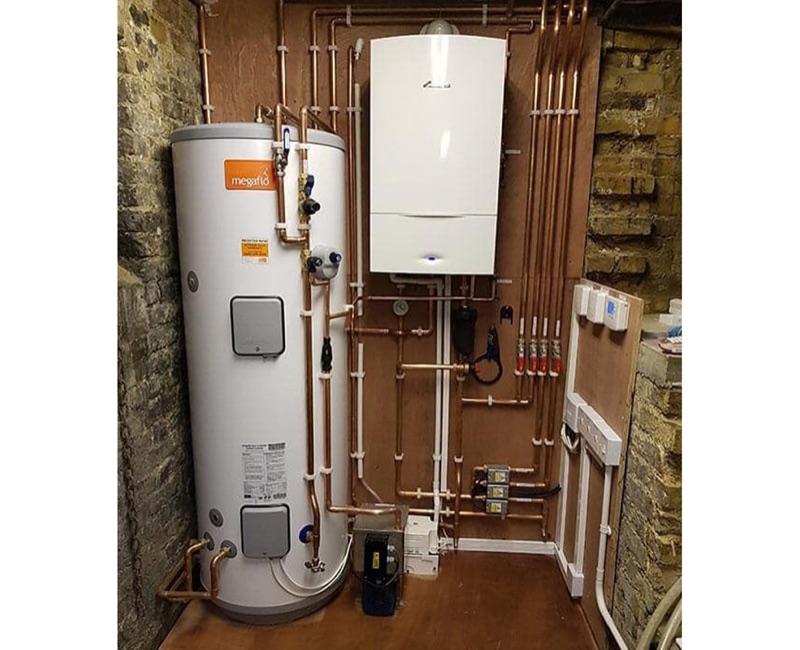
Which control actually sets the hot-water temperature?
On a conventional boiler-heated cylinder, the cylinder thermostat requests or stops heat for the stored water. The programmer decides when heating is allowed. The room thermostat concerns space heating, while the boiler control sets or manages the water leaving the boiler. These are separate jobs, even when several functions appear on one modern control screen.
That distinction answers a common first question: a lit hot-water programme does not necessarily mean the boiler should be firing continuously. It may simply mean that cylinder heating is enabled during that period. Whether heat is actually needed depends on the temperature control and the installation. Likewise, moving the room thermostat is not a reliable way to change the stored hot-water target.
Identify the cylinder, heat source and actual controls before adjusting anything. Electric immersion heaters, integrated cylinder controls and app-managed systems need their own instructions. A guide for a strap-on thermostat on an older copper cylinder is not a wiring or adjustment guide for every unvented cylinder. Keep electrical covers closed and do not reset concealed safety devices. If the water has suddenly become dangerously hot, stop using the affected outlet and arrange assessment rather than experimenting until it feels acceptable.
Source: Centre for Sustainable Energy: separate heating-control functions
Recognise the control without opening its cover
A traditional cylinder thermostat may be an externally visible unit with a dial, attached to the cylinder. Other installations use a sensor connected to a controller, a control within a manufacturer housing, or a separate thermostat associated with an immersion heater. The visible shape is a starting point for identification, not proof that any replacement with a similar dial is compatible.
Read accessible model labels and the installation handover information. Photograph the cylinder name and the controls from a normal, dry position. If a control can only be reached by removing a cover, lifting insulation around electrical equipment or climbing into an awkward cupboard, leave it for the appropriate professional. You should not need to expose wiring to explain what system is installed.
Avoid treating a numbered dial as a temperature scale unless its manual establishes the mapping. A number such as three or four on one product cannot safely be transferred to another. The same applies to a red mark added by an installer or previous resident: ask what it represents rather than assuming it is a tested safety limit. Keep any original operating label visible, and request an explanation if several contradictory notes have accumulated in the cupboard.
| Visible item | Main question it answers | What it does not prove |
|---|---|---|
| Hot-water programme or timer | When is this heating mode enabled? | That heat is being delivered continuously |
| Cylinder temperature control | What stored-water target is requested? | The measured temperature at every tap |
| Boiler flow setting | What heat-source temperature is requested or managed? | That it is the correct target for every mode |
| Immersion boost control | When is the electric heating mode enabled? | A universal cylinder temperature or heated volume |
| Outlet mixing control | How is delivered hot and cold water blended? | That the cylinder storage target has changed |
Why the hot-water timer can be on while the boiler stays off
A resident posting to askaplumberUK described moving into a home with an immersion heater, a cylinder dial and a Honeywell programmer. They could see the scheduled hot-water light but did not always see the boiler running, and were unsure which control actually requested heat. The discussion provided an explanation, but did not establish an independently verified repair or the complete wiring arrangement.
The useful question is whether the cylinder needs heat during an enabled period. If the intended temperature has already been reached, the programme being on is not by itself evidence of a fault. Conversely, an illuminated programme with persistently cold water does not establish that the thermostat is defective. The heat source, request and delivery path need to be considered together.
For an enquiry, describe what the controls display and what service you actually receive. For example, say that the morning programme appears enabled but all hot taps remain cold after the normal heating period. Do not report “the timer works” solely because its light is on. Equally, avoid buying a timer because the boiler did not fire at the exact moment you looked. The observed result and the meaning of an indicator are different pieces of information.
Source: Public new-occupant control question; no verified repair outcome
Storage temperature and comfortable tap temperature are different decisions
Drayton’s HTS3 household explanation recommends a 60–65°C setting for that conventional cylinder control. HSE’s water-system guidance describes storing hot water at least at 60°C when temperature is used as the control strategy for legionella risk. That is guidance about the water system, not an instruction that every bath or shower should discharge water at the storage temperature.
HSE also identifies thermostatic mixing valves as a way to reduce delivery temperature where scalding is a risk. The appropriate arrangement depends on the installation and its users. Do not solve uncomfortable or unexpectedly hot outlets by choosing an arbitrary lower storage setting from a forum, and do not assume a mixer is working correctly simply because one is fitted. Ask for both storage control and safe delivery to be considered.
A March 2024 homeowner discussion described very hot taps in a family home and the apparent conflict between comfortable use and stored-water hygiene. Replies offered conflicting advice. The owner later reported cooler outlet water after changing the operating arrangement, but the discussion did not independently verify the diagnosis or confirm safe storage and control operation. A reported improvement at a tap is not a complete system assessment; this guide keeps storage and delivery decisions separate. If children or other vulnerable occupants could reach the outlet, explain that when arranging help and prevent exposure while the problem remains unresolved.
Heat-pump and managed disinfection arrangements require their own manufacturer and commissioning instructions. This article does not replace those with a universal daily dial setting or sanitisation schedule. Keep the documented control strategy intact until a competent person has reviewed any proposed change.
Sources: Drayton HTS3 manufacturer guidance · Public discussion about very hot taps, March 2024; unverified
Source: HSE: hot-water storage, system assessment and scalding control
The boiler must be able to supply the heat the cylinder requests
Another public DIYUK question concerned a boiler flow setting of 55°C alongside a cylinder thermostat set to 60°C. The owner asked whether the cylinder control could somehow achieve the higher target despite the lower heat-source setting. The post is evidence of the control confusion, not a verified diagnosis of that installation or an instruction to copy either temperature.
For the conventional arrangement described in its HTS3 guidance, Drayton says the boiler control temperature needs to be higher than the cylinder thermostat setting. The cylinder control requests heat; it does not create extra heat beyond what the source can supply. However, do not assume that a modern boiler uses one fixed temperature for both radiators and hot-water charging. The installed control strategy may manage those demands differently.
Before changing settings for efficiency, establish which mode a displayed number belongs to. A radiator-flow adjustment and a domestic hot-water target may be separate on one system but linked on another. Ask the installer to explain how hot-water charging is maintained when space-heating settings change. Keep that explanation with the equipment records. It is more useful than applying a general low-flow-temperature tip without knowing whether it also changes cylinder heating.
Source: Public question about boiler flow and cylinder target; no verified outcome
Turning the thermostat higher does not make it heat faster
The HTS3 manufacturer explanation states that raising the cylinder thermostat target does not increase the heating rate. The request is for a different end temperature; the heating performance depends on the installation. If the water has run out before an evening bath, turning a dial to maximum is therefore not a reliable way to obtain a quicker recovery, and it can leave a higher target in place afterwards.
Describe whether the problem is insufficient stored hot water, a missed heating period or slow recovery after normal use. Those situations call for different questions. A household whose schedule heats only after the morning rush has a different starting point from one where the normal charging period runs but the cylinder remains cold. Neither situation is diagnosed by the position of the thermostat alone.
Use ordinary experience rather than repeated draw-off tests. Note when the water was last satisfactory, which heating period should have occurred and whether boost changes the available service. Do not repeatedly run very hot water to judge performance by touch. If a schedule change is appropriate, use only the documented user controls and ask how it fits the actual heat source and household demand. A scheduling decision should not conceal a newly developed failure.
An immersion boost and a cylinder thermostat do not answer the same question
A boost button normally concerns a period of heating, but its exact function belongs to the fitted controller and hot-water system. It may enable an electric heater independently of a boiler-heated arrangement. The label does not establish the temperature target, the size of the heated reserve or whether the normal heating mode is healthy.
If boost restores some hot water while the usual programme does not, report both outcomes. That is useful evidence of a difference between modes. It is not proof that the thermostat, timer or lower heater is the failed item. On installations with more than one heat source, ask which source is intended for routine use and which is backup, and request an explanation of the relevant switches.
Do not switch off an unidentified supply simply because an online reply calls every immersion a backup. Some homes rely on electric heating for their normal hot water. Equally, do not leave an unexplained backup arrangement as the permanent answer to a failed boiler-heated circuit. Confirm the actual tariff and intended operating arrangement before making cost comparisons; an illuminated switch cannot establish either. Keep electrical housings closed even if another resident says a thermostat adjustment is hidden immediately beneath the lid.
A dial setting is not a measurement of the water at the tap
The displayed or dialled target tells you what the control has been asked to achieve. It does not demonstrate the temperature throughout the stored water or at every outlet. If a tap becomes unexpectedly hot, or one shower remains cold while other outlets are satisfactory, preserve that distinction. Do not assume the same cylinder adjustment is the answer to both.
Ask whether the complaint affects one outlet, several outlets or the entire hot-water service. Also distinguish water that is too hot from water that fluctuates during use. These descriptions help the professional decide whether the investigation should include outlet controls as well as the cylinder and heat source. The visible thermostat target is one observation among several, not a complete performance test.
Avoid diagnosing the control by the temperature of the airing cupboard or an accessible pipe. Surfaces can be dangerously hot, and warmth does not prove that the intended water has reached the intended temperature. Do not turn the dial backwards and forwards to force clicking or repeatedly trigger the system. If a professional measurement is needed, ask what was measured and where, so that a recorded cylinder finding is not confused with a reading from a mixed outlet.
Overheating, repeated cut-outs and safety discharge need assessment
A temperature control and a thermal safety cut-out have different roles. A normal user temperature adjustment must not become an attempt to defeat a protective shutdown. If a concealed cut-out has operated, do not remove covers or repeatedly reset it to restore hot water. The cause and the appropriate recovery procedure need assessment for the actual equipment.
The Megaflo Eco SystemReady instructions explicitly prohibit bypassing thermal cut-outs and tampering with safety valves. For discharge from its temperature-and-pressure relief valve, they direct shutting down the heat source, preserving the water supply and contacting a competent unvented-water-heater installer. Follow the instructions for the identified product; do not turn a general cylinder article into a rule to close every valve or drain the system.
If you can safely identify and operate the normal heat controls, follow the product’s emergency guidance. Do not touch wet switches or reach through leaking water to isolate electrical equipment. Keep people away from unexpectedly hot discharge, steam, wet electrics or unstable surrounding surfaces and seek urgent help. A leak at a connection and water passing through a safety discharge route are different observations. Describe where water appears rather than blocking the outlet or assuming a new thermostat will resolve it.
Source: Megaflo Eco SystemReady issue 11: operation warnings and safety controls
Before replacing a thermostat, ask what the assessment has established
A replacement should address an identified control problem, not simply the most visible item on the cylinder. Ask whether the issue concerns sensing the stored temperature, enabling the heat source, delivering heat, or controlling the outlet. Those are different parts of the hot-water service and may require different work. “The water is cold” is a symptom; it is not yet a thermostat diagnosis.
If a control was recently replaced, provide the model and job description. Report whether the original symptom changed, disappeared temporarily or remained exactly the same. Do not move the new thermostat, alter its wiring or fit another part to test an online suggestion. The previous findings and the result of the work should guide the next assessment.
Compare proposals by scope. Ask whether the price covers investigation, compatible control selection, fitting and checking the intended operating modes. If another component or a wiring change is proposed, ask why that is needed and what outcome will be verified. These are questions for informed authorisation, not instructions to perform electrical tests yourself. Keep the explanation in writing so that a later fault can be assessed against what was actually repaired.
Get a usable operating explanation at handover
After an installation, repair or house move, ask for a short explanation using the controls actually in front of you. It should identify the normal hot-water programme, stored-water target, routine heat source, any backup mode and the correct response to a warning. Ask which settings are ordinary user adjustments and which should be left to the installer.
Keep photographs of the labelled controls with the matching manuals and service records. Record the agreed normal arrangement, rather than copying a previous resident’s unexplained switch positions. If an app is involved, confirm which physical controller and appliance it operates. A schedule visible in an app is only useful when you understand which heating mode it controls.
For an AK enquiry, send the cylinder and controller model, your Greater London postcode and the actual symptom: too hot, cold, short supply, boost only or a recurring shutdown. AK’s £60 charge covers attendance only; specialist cylinder and control work is scoped and quoted separately. No VAT is added. Clear information helps arrange the appropriate assessment without promising that a thermostat replacement is already the answer.