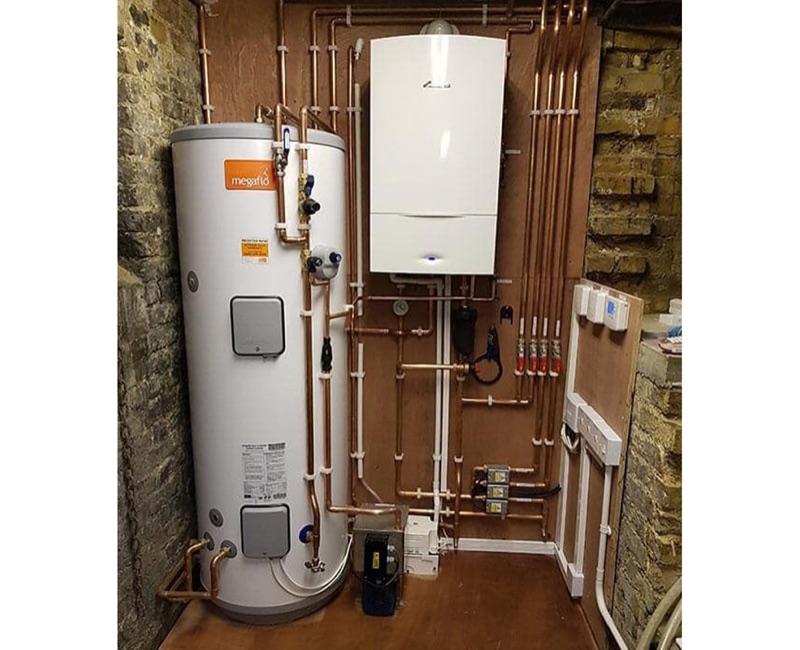
A leaking hot-water cylinder does not always need replacing
Water beside a hot-water cylinder can come from a pipe connection, an immersion-heater area, associated controls or the storage vessel itself. Water passing through a tundish is a different observation from water escaping onto the floor. The first task is to identify the equipment and the route the water is taking, without opening covers or disturbing fittings. A puddle at the base does not prove that the cylinder body has failed.
Arrange urgent help if water is reaching electrical equipment, the leak is spreading rapidly, or there is hot, forceful discharge, steam or unusual overheating. Keep people away from hot water and wet electrics. Stop the heat source using only a familiar, dry, safely accessible user control; if that cannot be done safely, stay clear and obtain urgent assistance. Do not reach through water to operate a switch.
The assessment should answer a specific question: is the repair at a replaceable connection or component, or has the vessel or its integral connection failed? Neither answer can be established from the amount of water on the floor alone. This guide helps distinguish those possibilities and explains why the system type matters before anybody suggests tightening, draining, patching or ordering a replacement.
| Visible location | Question for assessment | Avoid assuming |
|---|---|---|
| Around a pipe joint | Which connection and water circuit is leaking? | The storage vessel has failed |
| Near an immersion cover | Is water from the assembly, seal, connection or above? | It only needs tightening |
| At the base or casing seam | Where did the water first escape? | The lowest wet point is the source |
| Through a tundish | Which discharge condition is present? | Closing every valve is appropriate |
| More than one location | Are discharge and physical escape both occurring? | One symptom explains all the water |
First separate escaping water from safety discharge
Look only from a safe position. Is water visibly dripping from a joint or casing onto the floor? Or is it passing through the small visible air gap called a tundish and continuing down discharge pipework? Both need attention, but they do not justify identical first actions. If you cannot distinguish them, describe what you can see and obtain immediate advice for the actual cylinder.
The Megaflo Eco manual tells users to stop heating and contact a competent installer for a fault involving discharge. For temperature-and-pressure relief discharge, it specifically warns against turning off the water supply. Gledhill's StainlessLite Plus user instructions similarly distinguish hot continuous discharge and preserve the cold supply while it remains hot. This is why generic advice to close every valve is unsuitable for an unidentified cylinder problem.
Do not touch the discharge to decide whether it is hot, block its outlet or operate a relief valve as a test. A small drip does not establish its cause, and switching the heat off does not make all stored water immediately cold. Report any hot-water or steam symptoms already observed without reproducing them. Where water is escaping elsewhere as well, report both locations. The person advising you needs to know about the safety discharge before giving isolation instructions for the physical leak.
Sources: Heatrae Sadia: Megaflo Eco safety instructions, page 4 · Gledhill: StainlessLite Plus user instructions, page 23
Vented, unvented and thermal-store systems have different water paths
Use the full product name on accessible paperwork or a label. A traditional vented cylinder is not the same arrangement as a mains-fed unvented cylinder. Range Cylinders' April 2025 Albion instructions show a cold feed from a storage tank, a top hot-water and expansion connection, and separate heat-source flow and return connections on indirect models. A combination cylinder can incorporate its feed tank rather than relying on a separate loft tank.
An unvented cylinder uses a different supply and safety arrangement. Meanwhile, the PulsaCoil Stainless manual describes an open-vented thermal store supplying domestic hot water through a separate mains-fed assembly. Strong flow at the hot tap therefore does not prove that the stored water itself is in an unvented potable-water cylinder. “Immersion”, “tank” and “boiler” are often used loosely in household descriptions; the model label is more dependable.
These differences affect what can continue feeding a leak and which circuit needs investigation. Do not choose a valve because it resembles one in a video. If identification is uncertain, send an overall photograph taken without moving pipes, followed by an accessible label photograph. A competent assessment can establish the layout. You do not need to map every pipe or enter a loft to make a useful initial report.
Sources: Range Cylinders: Albion vented instructions, April 2025 · Gledhill: PulsaCoil Stainless manual, April 2024
Water at the bottom may have started higher up
Gravity can carry water down pipework, the cylinder exterior and its support before it becomes visible as a puddle. The place where it collects is therefore not necessarily the place where containment first failed. A wet platform or a drip appearing at the bottom edge needs tracing, rather than an immediate conclusion that the bottom of the vessel has rusted through.
In an opened DIYUK account, a resident reported disturbing a connection while fitting another insulation jacket around a copper cylinder. Water then ran down onto the supporting wood and floor. The account was not independently verified and did not establish a completed permanent repair. It does illustrate why a floor-level symptom can begin at a connection elsewhere, and why moving material around old pipework is not a harmless diagnostic step.
Observe the highest wet point already visible without reaching behind the unit. Note whether an exposed pipe above the cylinder is also wet. Do not strip foam insulation, remove a fixed casing or pull back tightly fitted materials to chase the trail. Avoid pushing tissues into electrical housings or hot, inaccessible gaps. A safe photograph showing the surrounding pipes can be more useful than a very close photograph of the puddle, because the close view removes the route the water may have followed.
Sources: DIYUK: owner reports disturbed connection and water tracking
A connection leak may belong to the heating circuit
An indirect cylinder transfers heat from another source through a coil. Its heat-source connections are distinct from the stored domestic-water connections. A leak beside a lower connection can therefore raise a different question from a leak on the cold feed or hot outlet. The Albion manufacturer's diagram makes those separate connections explicit; the position alone is not enough to identify one on an unfamiliar installation.
One DIYUK owner describing a vented indirect cylinder reported leakage at a bottom connection believed to be associated with the coil. Their concern was whether disturbing a deteriorated fitting would leave them needing a replacement cylinder and without hot water. The thread did not establish a verified final outcome. It is a useful example of why the damaged connection and its surrounding material need assessment together.
Tell the engineer if boiler pressure has also fallen, but do not treat that as a diagnosis or repeatedly refill the heating circuit to compensate. Equally, a normal boiler gauge does not prove that the cylinder connections are sound. Record which services were operating when the leak was noticed and any recent heating work. Do not attempt to drain either circuit or loosen the joint to identify which water it carries. The professional investigation should name the affected circuit and explain what must be isolated before repair.
Water around the immersion heater: seal, heater or cylinder connection?
A leak near an immersion heater is not automatically a failed cylinder, but it is also not automatically a loose washer. The relevant possibilities include the heater assembly, its seal and the connection into the vessel. Water arriving from above can confuse the appearance further. Electrical covers should remain closed, and a leaking heater must not be used merely because it still produces hot water.
Gledhill's StainlessLite Plus instructions identify an O-ring at the immersion connection and warn that excessive tightening can damage it. That is installation information for the person doing the work, not permission to try a spanner on a wet cylinder. It shows why “tighten it a little more” is not a reliable universal repair. Different models and generations must use their specified parts and procedures.
An opened DIYUK owner account described a small leak believed to be around the heating element, followed by a proposal to replace the whole cylinder. No final diagnosis or repair was verified in the discussion. The useful question is what evidence distinguishes a serviceable heater or seal from damage to its mounting area. Ask for that distinction before comparing prices. Do not remove the heater cap, dry internal terminals with a hairdryer, apply sealant around live equipment or switch to another heating mode without professional advice about the remaining leak.
Sources: DIYUK: heater-area leak and replacement uncertainty · Gledhill: StainlessLite Plus installation instructions and guarantee terms
A tundish drip and a wet floor can happen together
A March 2023 DIYnot resident reported substantial hot-water flow through a tundish, reducing after the heater was switched off, plus a separate cooler drip around the heater area. They had recently moved in and were unsure which valves did what. No final repair was verified. The practical lesson is to report both symptoms rather than assuming that everything wet in the cupboard comes from one harmless overflow.
The tundish makes discharge visible; it is not a repair device. Water passing through it can indicate a problem requiring assessment of the cylinder's safety and control arrangement. Water spilling out of the discharge route or leaking from another fitting adds a containment problem. Do not try to cure either by covering the gap, plugging a pipe or diverting it into an improvised closed container.
Our dedicated tundish guide explains the discharge-related questions in more detail. For a physical-leak enquiry, say whether the floor becomes wet even when no discharge is visible, if that is already known from ordinary observation. Do not restart heating to test the relationship. A change from a stream to a drip after switching off is useful history, but it does not establish that the appliance is safe to resume using or leave unattended for a particular number of hours.
Sources: DIYnot: simultaneous discharge and heater-area drip, March 2023 · More on unvented-cylinder tundish dripping
Outer casing damage is different from a failed water vessel
The Megaflo Eco specification distinguishes an outer casing, insulation and an inner stainless-steel water container. A mark or damaged finish on the outside is therefore not, by itself, evidence that the pressure-containing vessel has failed. Conversely, water emerging through a casing seam cannot be dismissed just because the exterior looks intact elsewhere. The source may remain concealed until the appliance is professionally assessed.
Do not scrape rust, cut insulation or lever off trim to settle that question. Report what is visible: fresh water at a seam, old dry staining, deformation, or a connection that appears to be moving. If the unit looks distorted or its support is damaged, keep clear and seek urgent assessment. Do not press on a bulge or attempt to reposition a full cylinder. The weight and condition of the installation matter independently of whether the leak is fast or slow.
A repair proposal should distinguish an external component from the vessel and its integral fittings. Ask where the water is escaping and what inspection supports the conclusion. A photograph may help plan the visit, but it cannot guarantee that a hidden connection remains serviceable. If the vessel is confirmed defective, obtain the appropriate replacement or manufacturer remedy rather than attempting an improvised patch to restore hot-water service.
Sources: Heatrae Sadia: Megaflo Eco specification and construction
Stopping supply is not the same as draining the cylinder
Do not assume that using up the hot water empties a cylinder. In normal operation, replacement water enters as domestic hot water is drawn. Nor does switching off the heat source remove the water already stored. These distinctions explain why a leak can continue after a household has stopped heating or after the taps no longer feel hot.
The appropriate isolation depends on the installation and the fault. A vented feed arrangement, an indirect heating coil and a thermal store do not become the same circuit because they share one cupboard. Gledhill's StainlessLite Plus manual also warns that incorrect draining can damage the cylinder. Its draining procedure is not reproduced here: opening unidentified valves or using a hot tap as a substitute is not a safe universal method.
For an ordinary physical escape of water, ask the attending professional or emergency adviser to confirm the correct isolation for the identified system. Tell them first if there is safety discharge, overheating or a wet electrical area. If they give model-specific instructions, explain immediately if the named control is absent, inaccessible or unclear. Do not force a valve to make the installation match the instructions. A supply being isolated also does not make it appropriate to turn an immersion heater back on; safe restoration needs the system's condition to be established.
A slow drip still needs a plan, especially before leaving home
The size of the puddle is a poor measure of the total consequence. Water can enter timber, insulation or the ceiling below without collecting neatly in front of the cylinder. A small visible drip may also be easier to miss between heating periods. Describe the actual spread and affected surfaces, not just whether a bowl appears to be keeping up.
If a container can catch a cool drip from a safe accessible position, it is only temporary protection while help is arranged. Do not place it against electrical equipment, block a discharge outlet or rely on it while leaving the property unattended. Move possessions only where doing so does not require contact with wet electrics, hot pipes or damaged flooring. Keep people away from an affected ceiling or unsafe support and report the damage when seeking help.
An overnight trip or a difficult appointment schedule does not establish a safe waiting period. Ask for the system to be made safe and for any temporary arrangement to be explained, including what must remain off. If the advice depends on a particular isolation, make sure the person understands which type of cylinder is present. Avoid treating a stranger's report that their drip stopped after closing a valve as assurance that the same action protects your home.
Deciding between a connection repair and replacement
Not every cylinder leak justifies a new cylinder. A sound vessel with a repairable external connection presents a different decision from a confirmed vessel failure or an integral connection that cannot be reliably repaired. The assessment should explain that boundary. The condition of the surrounding installation and access can affect the work, but neither age alone nor a generic online life expectancy settles it.
For a deteriorated connection, ask what happens if the planned repair exposes damage that prevents reassembly. The owner worried about a bottom coil connection was asking a practical question: how long might the household be without hot water if the first option cannot proceed? A useful proposal identifies that contingency, the point at which further authorisation is needed and the available replacement route. It should not promise that every old connection will survive disturbance.
If you also want an upgrade, separate it from making the current leak safe. Moving from vented storage to an unvented arrangement is a system decision requiring suitability checks, rather than simply exchanging one similarly sized tank. Discuss the heat source, water supply, discharge provision and access with the installer. Do not let a future upgrade plan become a reason to apply putty to a leaking vessel or continue operating equipment whose condition has not been established.
For a recent installation, preserve the evidence and check the actual warranty
Record the model, installation date and installer details if available. A newly discovered leak should be reported promptly to the installation provider or relevant manufacturer support route, without delaying urgent action needed to protect people or property. Keep photographs of visible symptoms and the written account of where the leak was found. Avoid dismantling or discarding components before the responsible provider has explained any inspection requirements.
Cylinder guarantees can distinguish the storage vessel from controls and other components. Gledhill's published terms illustrate that distinction and attach conditions to a claim. They are not a promise that your installation, labour costs or consequential water damage are covered. Use the documents belonging to the product and purchase, and obtain the provider's position before assuming a replacement will be free.
After work, the handover should identify the actual failed item, the work completed and any remaining restriction. Ask whether the leak has been checked under the operating conditions relevant to the original report, rather than only while the system was cold and unused. The professional should decide how to test safely. Keep any follow-up instructions with the record. If water reappears, report the location and whether it matches the original route instead of immediately assuming the new component has failed too.
Sources: Gledhill: StainlessLite Plus installation instructions and guarantee terms
In a flat, report the cylinder and the damage below separately
Notify the landlord, managing agent or building emergency contact promptly when water may affect another home or a shared part of the building. Describe the source cupboard and the affected ceiling or floor as separate locations. A downstairs stain does not tell the person upstairs which cylinder connection has failed, and making the plumbing safe does not automatically complete drying or repairs to the building.
Do not operate communal valves or access another property's equipment without the appropriate arrangements. If the familiar contact is unavailable and the leak is active, seek urgent assistance rather than waiting for a routine reply. Keep a record of the report and professional findings. Responsibility for costs, insurance or reinstatement depends on the actual tenancy, ownership and policy arrangements; a forum comment cannot settle those questions.
For an AK enquiry, describe the product label, visible leak location, whether any tundish discharge is present and whether water is near electrics. £60 covers attendance only; ordinary plumbing work is £160 per hour. AK is not VAT-registered, so no VAT is added. Cylinder specialist investigation or replacement requires a separately confirmed scope and quote. The appropriate next step is to establish the source and safe repair options, not to order a complete cylinder solely because water has reached its base.