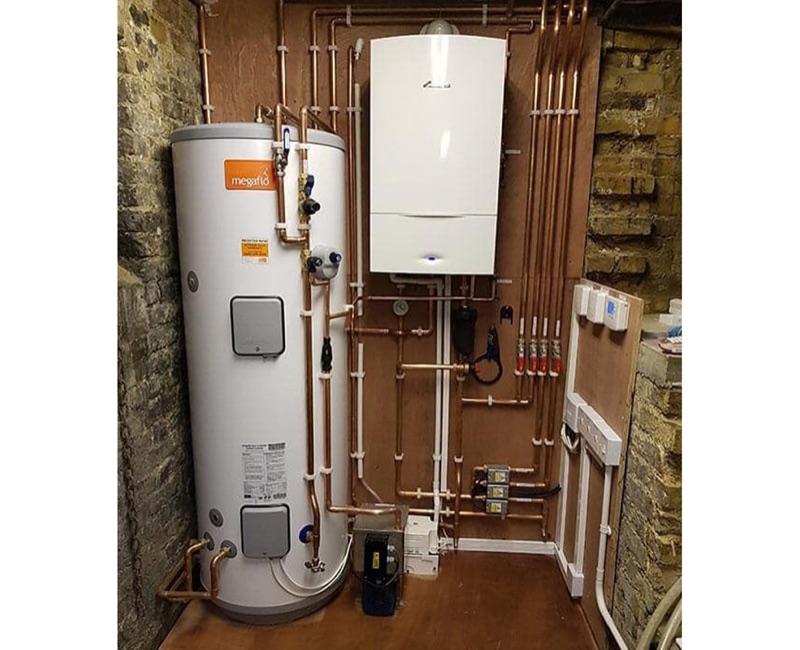
Hot water but no heating: establish what is actually working
If you have hot water but no heating, first identify what heats the tap water and whether every heating zone is cold. Then check the ordinary heating schedule, room-temperature setting and displayed demand using the correct user instructions. Working hot taps do not automatically prove the boiler, thermostat or heating circulation is sound. A cylinder may be hot because its electric immersion is working independently.
The useful sequence is to establish whether heating is being requested, whether the boiler responds and whether heat reaches the intended rooms. Each stage can fail differently. A lit thermostat, an audible click or a warm pipe is one observation, not a complete test of the system. Avoid ordering a diverter valve or replacing a thermostat solely because somebody with the same symptom needed one.
Stop ordinary checks if there is a gas smell, a carbon monoxide alarm or suspected fumes. Leave the building, avoid electrical switches and flames, and call the National Gas Emergency Service on 0800 111 999 from outside, well away from the building. Keep away from wet electrical equipment, active leakage and dangerously hot discharge. Explain those hazards when seeking help rather than describing the situation only as cold radiators.
For a stable system without those warning signs, the checks below are external observations and normal user controls. They do not involve removing covers, testing live terminals, forcing valves or repeatedly resetting a boiler. The aim is to describe the failed stage clearly enough for the right investigation.
| What you observe | What it establishes | Next distinction |
|---|---|---|
| Hot taps supplied by a combi | The appliance can currently deliver domestic hot water | Heating request recognised versus heat delivered |
| Hot cylinder with immersion in use | Stored water has an independent possible heat source | Whether the boiler is operating at all |
| Thermostat displays a heating symbol | The control may be requesting heat; read its manual | Receiver and boiler response |
| One zone cold, others warm | The fault is not a complete loss of all heating | Zone control versus local distribution |
| Heating failed after controls were changed | A useful installation chronology | Professional compatibility and commissioning check |
| Neither heating nor hot water works now | Working-hot-water assumptions no longer apply | Known interruption, visible status and separate heat sources; use the both-services branch |
Sources: HSE: gas safety for homeowners
A hot cylinder does not prove the boiler is running
A combi normally heats tap water through the appliance when it is demanded. A home with a separate cylinder stores hot water, which can remain available after the boiler has stopped. Some cylinders also have an electric immersion heater. These arrangements make the statement hot water works mean different things, even before any component has failed.
The Megaflo Eco indirect manual provides a specific example: its backup immersion has a dedicated electrical supply and is not controlled by the boiler or space-heating programmer. Hot water produced that way is therefore not evidence of boiler operation. Identify your own cylinder and controls rather than assuming every installation is wired like that example.
An August 2024 DIYUK poster described a newly purchased home as having both a combi and an immersion tank, with hot water but no heating and no pressure shown. The account did not establish the actual system type or a completed repair. It illustrates why the equipment label, accessible model number and handover information are more useful than accepting an unfamiliar system description as certain.
Record whether the hot water was already stored, whether an immersion or boost was in use and whether the boiler display changed during normal operation. Do not switch unfamiliar equipment repeatedly to prove the source, drain the cylinder or open immersion covers. If the arrangement is unclear, say that. A professional can identify the heat sources before drawing conclusions from the working taps.
Sources: Megaflo Eco: independent backup immersion on indirect models · Public homeowner account: uncertain boiler and cylinder arrangement
No hot water or heating: when both services are unavailable
If neither heating nor hot water is available, the symptom has changed: do not continue assuming that domestic hot water proves any part of the boiler works. This is also different from the inverse problem, where the radiators heat normally but the hot taps stay cold. Establish the present condition before following a fault route intended for only one service.
First distinguish cold water flowing from a hot tap from no water flowing at all. If cold outlets are also dry, check your water supplier's interruption information and report the loss of water supply. A boiler investigation alone may not explain that. If water flows but stays cold, note whether it was briefly warm from water already in the pipe or cylinder, and when genuinely hot water was last available.
A September 2024 DIYUK owner reported neither service working despite an on setting and a clicking thermostat; hot water had worked earlier that day. They supplied more equipment photographs, but no completed diagnosis was visible. The account illustrates why yesterday's or this morning's working service is not proof of present operation, and why a control photograph alone may be insufficient.
Look for a wider known interruption before assuming an appliance part has failed. Are household lights and ordinary electrical services already working? Is there a supplier notification about a power or fuel interruption? If you use prepayment, check the accessible meter's credit or supply message using your supplier's instructions. Do not light another gas appliance as a test, open a meter, disturb gas valves or attempt reconnection outside the supplier's directions. If gas or carbon monoxide danger is suspected, use the emergency action at the start of this article instead of continuing checks.
At the appliance, record whether the external display is blank, shows a normal state or gives a complete fault code. Note a known power cut, an accidentally changed ordinary control or an altered clock. A blank display does not identify the failed electrical component, and an illuminated display does not prove that the burner, pump or controls can operate. Do not open fuse carriers or covers, test live wiring or repeatedly reset a tripping circuit. EDF's checklist includes supply and control checks before professional escalation; use only the safe user-level checks applicable to your equipment.
On a confirmed combi, loss of a shared heat source or operating supply can affect both services, but the symptom does not prove one specific fault. With a boiler and cylinder, separately identify the boiler-fed heating, stored water and any immersion supply. Two unavailable services can reflect a shared interruption, separate faults or hot storage that has simply been used up since heating stopped. Do not switch on an unfamiliar backup heater as a diagnostic shortcut.
The Greenstar 4000 combi manual directs persistent faults to professional support with the code and appliance details. Give those details alongside which services are unavailable now, known interruptions and any vulnerable occupants or frost risk. In a managed block, report whether neighbours are affected and contact the responsible heating operator. If supplies appear available but both services remain absent, arrange assessment rather than waiting for repeated resets to succeed.
Sources: Public homeowner account: both services stopped despite an on setting · EDF: supply and control checks when both services are unavailable · Worcester Greenstar 4000 combi: persistent-fault reporting, page 16
Check the heating request using the normal controls
Look at the active heating programme and the thermostat's displayed room temperature and target. A schedule can permit heating while the room is already warm enough for the thermostat to stop requesting it. Conversely, a higher target may not start heating if another time control has switched the heating period off. These are separate conditions rather than competing explanations.
The Drayton Digistat 30002 and RF601 user guide distinguishes the actual room temperature from the setting being adjusted. It also explains that its flame symbol represents a demand for heat, and that a programmer can prevent heating. Other products use different symbols, so use the guide for the control in front of you rather than interpreting every flame or radiator icon identically.
If you understand the controls, select the intended heating period and a sensible target above the current room temperature using the user instructions. Note the response, then restore the desired programme after the check. Turning the target to its maximum is not a way to make the room heat faster, and leaving several overlapping overrides active makes later behaviour harder to interpret.
Check the displayed day and time, particularly after a power interruption or seasonal clock change. Note an away, holiday or heating-off state without exploring installer menus. If a control is locked, blank or unfamiliar, photograph the model and display rather than trying random button combinations. Describe what you can see and which ordinary setting you changed.
Heating mode and hot-water mode are not the same setting
Many systems allow domestic hot water to remain available while space heating is disabled. That can be intentional outside the heating season. Check the actual heating mode on the boiler or associated controller; do not assume a lit appliance display means that every service is enabled. A control labelled hot water may have no effect on the radiator schedule.
For example, the Worcester Greenstar 4000 GR4700iW C manual, edition 2020/09, documents separate central-heating and hot-water functions, with some timed options depending on fitted control accessories. The matching GR4700iW S system-boiler manual also directs users to the heating controller's instructions. Similar-looking front panels do not justify transferring a button sequence between models or installations.
Identify both the boiler and its controller when looking for instructions. A wall thermostat, plug-in timer, wireless receiver and phone app can represent different parts of one arrangement. Record which control you used and what changed. An app saying that a schedule was saved does not by itself show that the appliance has acted on it.
Avoid changing flow-temperature limits, service parameters or system configuration to force a response. Those settings can be linked to the installation design, particularly where underfloor heating or more than one circuit is present. If the normal heating mode and programme appear correct but no warmth follows, that is useful evidence for an engineer; it is not a reason to keep increasing every available setting.
Sources: Worcester: Greenstar 4000 combi user manual, 2020/09 · Worcester: Greenstar 4000 system user manual, 2020/09
A thermostat demand symbol is not proof of boiler firing
A heating request must reach the rest of the system and be acted upon. With wireless controls, the room unit and receiver are separate devices; with wired controls, the electrical connections still need to function correctly. The homeowner can record visible indicators, but establishing the complete signal path is different from seeing a symbol on the room display.
Check a low-battery warning against the product's user instructions. Replace user-accessible batteries only as specified for that model. Do not remove a mains-powered receiver cover, bridge terminals or copy a pairing procedure intended for another version. If communication appears lost, record the control model and exact indication and ask for the correct support procedure.
A March 2025 DIYnot owner described a battery warning, changed batteries and continued to see an on indication without sustained heating. Their later update reported a professional replacing the thermostat and receiver, followed by further work to resolve a circulation problem. Heating was then reported restored. This is one unverified outcome, but it shows why resolving a control issue and confirming heat delivery are distinct stages.
For your enquiry, separate the observations: thermostat requests heat; receiver indicator changes or does not; boiler displays a response or remains unchanged; rooms remain cold. Do not interpret a hum as confirmed combustion or touch internal parts to decide what is running. This structured description helps an engineer test the sequence without assuming that the first visible symptom is the only fault.
Sources: Public homeowner account: controls and circulation investigated separately
With a boiler and cylinder, heat must reach the correct circuit
Where a boiler heats both a hot-water cylinder and the rooms, the system needs a way to supply the appropriate circuit. The arrangement may use separate zone valves or a valve that routes flow between services. The boiler can therefore respond to one demand while another control or flow path is not operating correctly. The exact layout must be identified before naming the failed component.
Drayton's mid-position valves 27101 and 27206 are a manufacturer example of equipment intended to serve heating, hot water or both. They are electrically operated components, not ordinary tap handles. Their existence explains a possible routing stage; it does not establish that your installation has one or that it is faulty.
In an October 2019 DIYnot account, a homeowner reported boiler-heated hot water but cold radiators after a period without using the heating. They reported heat returning after a valve intervention, but the thread did not establish a lasting professional repair. The useful lesson is the distinction between generating heat and directing it, not an instruction to manipulate a valve lever.
Do not latch valves open, remove actuator heads or strike pumps to obtain temporary warmth. Such actions can alter normal control and leave the underlying fault unresolved. Tell the engineer if somebody has already changed a valve position or attempted a workaround. Ask for operation to be checked through the intended controls, including the return from hot-water demand to heating when applicable.
Sources: Drayton: specified mid-position valve function · Public homeowner account: hot water working, heating route unresolved
With a combi, distinguish no heating response from no heat delivery
If the confirmed combi heats tap water normally, that is useful evidence that it can operate in domestic-hot-water mode at that time. It does not prove that the heating demand is reaching it, that its heating function is operating correctly or that water is circulating through the rooms. The same headline symptom can therefore require different professional tests.
Observe the external display during a normal heating request with hot taps closed. Does it show a heating state, remain unchanged, briefly respond then stop, or show a fault? Record the exact wording or code, including any alternating part. Do not remove the casing to listen more closely or keep cycling the appliance until it happens to run.
A diverter mechanism may be relevant on an installation that uses one, but the symptom alone is not a diagnosis. A quotation for a particular part should follow identification and testing. Replacing a part because an online discussion mentions it can leave a control fault or circulation problem untouched, and the apparent success of hot-water mode does not remove the need to assess heating operation.
Also distinguish continuous failure from a short interruption while hot water is being used. Describe whether heating returns through ordinary operation after the hot-water demand ends, without running taps for a prolonged experiment. If the whole house remains cold despite an understood heating request, explain that duration and pattern. The model manual and installation determine which behaviour is expected.
Sources:
One cold zone needs a different route from every room being cold
Map the scope before treating the boiler as the only suspect. Are all radiators cold, one floor cold, an underfloor zone unresponsive or just one emitter slow to warm? If another heating zone works normally, include that fact. It narrows the problem without proving that the boiler or every shared component is fault-free under all conditions.
Use the normal room and zone controls to check whether the affected area is intended to heat. A thermostat elsewhere may already be satisfied, while a separate zone has its own schedule. Note recent changes to room use or control location, particularly if a thermostat has been placed beside a separate heat source. Do not relocate wired controls or change manifold adjustments as a trial.
A radiator that is partly warm, a room that never reaches its target and a complete absence of heating response are different complaints. Our radiator guide covers those emitter and distribution patterns in more detail. This article is concerned with establishing the system's heating request and response, so it does not prescribe bleeding every radiator or changing all valve settings.
For mixed radiator and underfloor systems, allow the documented normal response time for the installed system rather than expecting identical surface warmth immediately. Report what the room temperature does and which control is requesting heat. Avoid barefoot or hand contact with unexpectedly hot surfaces. A professional may need to assess zone control and distribution separately from the boiler's ability to generate heat.
Sources:
Heating stopped after work: preserve the sequence of events
Recent work is important context. Note whether the heating last worked before a thermostat replacement, radiator alteration, bathroom refurbishment, power interruption or draining of the system. Include what was changed and by whom, but do not assume that timing alone proves responsibility. An unused heating function may only reveal an older problem when the weather turns cold.
In a 2024 DIYUK discussion, someone fitting Hive at a family member's home reported hot water but no heating and later discovered an existing wired thermostat. Raising that thermostat did not restore heating in the visible account, and manufacturer support was being considered. The discussion contained speculative wiring advice, not a confirmed repair. It supports getting the full control arrangement checked rather than assuming a new app proves successful installation.
If work was recently completed, ask the installer to review the heating operation and explain which controls should remain in use. Have the product references, invoice and handover instructions ready. Do not open receivers, join wires or copy terminal positions from another house; superficially similar control boxes may have different functions and wiring requirements.
After work involving the heating circuit, describe whether all zones were demonstrated and whether the fault was present immediately or appeared later. Any previous professional finding should be recorded separately from your observations. This helps avoid repeating an already unsuccessful intervention and gives the returning engineer a clear condition to reproduce safely.
Sources: Public family-home account: heating failed after control change
Read pressure and fault information without turning it into a reset routine
If the appliance has a visible pressure reading, record it along with whether the system is cool or has recently run. Use the matching user manual to interpret it. A sealed heating-circuit gauge does not measure the strength of the water coming from the kitchen tap, so good tap flow cannot be used to dismiss a heating-pressure concern.
Some systems and displays differ, and the absence of a familiar number is not a reason to start filling. Do not open an unidentified filling arrangement or repeatedly add water because an online guide gives a universal target. Report a falling reading, a previous top-up or visible leakage. The existing pressure-loss guide covers recurring loss rather than treating it as an ordinary heating-control adjustment.
Record any exact code before seeking help. A clear display does not prove that external controls and circulation are working, while a code needs interpretation for the correct brand and model. Repeated resets can erase a useful sequence without resolving the cause. If a fault returns, stop treating reset as a repair and arrange assessment.
Hot water availability should not distract from a deteriorating condition. If pressure changes rapidly, water escapes or the appliance behaves abnormally, describe that as well as the cold rooms. Where an unvented cylinder is discharging dangerously hot water, keep clear, leave the discharge unobstructed and seek urgent competent help. For Megaflo Eco temperature-and-pressure relief discharge, its manual instructs shutting down the heat source and immersion heaters while retaining the cold-water supply. Use only normal external controls if safely accessible; do not approach hot discharge or remove covers. Follow the matching safety instructions for other cylinder models.
Sources: Worcester Greenstar 4000: model-specific pressure and fault guidance · Megaflo Eco manual: temperature-and-pressure discharge safety, page 24
What the investigation and completed repair should establish
A useful investigation follows the actual installation from demand to response and distribution. Ask whether the engineer will assess the external controls as well as the boiler, and explain any cylinder, immersion, separate zone or recent alteration. A visit limited to appliance servicing may not automatically include every external control or circulation problem; agree the fault-finding scope.
The report should distinguish an observed condition, a tested fault and a suspected cause requiring more work. For example, a control requesting heat is different from confirmation that the boiler receives that request. A component replaced is different from evidence that the rooms now warm under the intended programme. These distinctions make a quotation easier to assess and reduce uncertainty if a return visit is needed.
Before accepting a repair as complete, ask for the affected heating function to be demonstrated through normal controls. Where the installation has separate hot-water and heating functions, confirm that both operate as intended without a manual workaround. Have temporary settings restored or clearly explained, and retain any new control instructions and part details.
If heating returns only briefly, record how long it lasted and whether the same conditions returned. Do not repeat an unsafe intervention to keep the house warm. Explain any occupants particularly affected by loss of heating and whether frost threatens the property when arranging support. The urgency comes from the conditions and household needs, not simply whether the hot tap still works.
Sources:
Arrange a heating assessment in London
Send AK your postcode, boiler model, controller model and the exact symptom. Say whether the hot water comes from a combi or stored cylinder, whether an immersion is in use and whether every heating zone is affected. Include visible codes and recent work. This helps agree the appropriate investigation rather than booking an assumed part replacement.
AK is based in North London and covers Greater London, with 24/7 telephone contact and emergency dispatch; confirm attendance timing when booking. The £60 callout covers attendance only. Ordinary plumbing is £160 per hour with work agreed, and no VAT is added because AK is not VAT-registered. Specialist boiler, heating-control, cylinder or electrical work requires its own confirmed scope and quotation. Ask about investigation, parts, access and any return visit before authorising work.
Sources: